
Precision Ratcheting Cutters & Fusion Tooling
Factory-direct OEM/ODM solutions engineered for zero-deformation cutting, severe service durability, and maximum mechanical leverage.
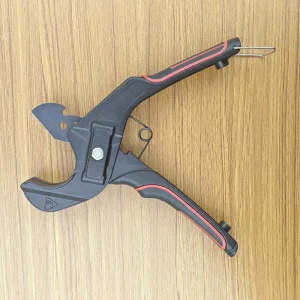
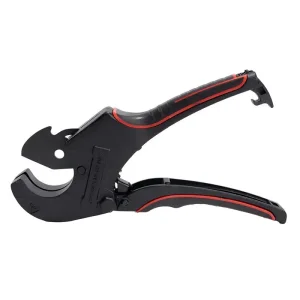
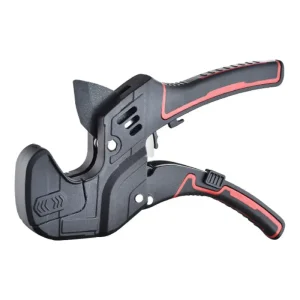
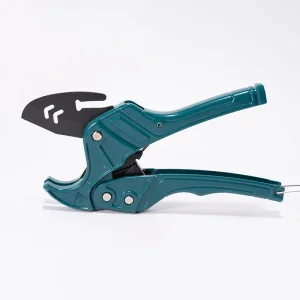
Global Commercial & Industrial Status of Ratcheting PVC Cutters
The global market for professional plumbing tools has transitioned from basic manual shear cutters to advanced high-leverage ratcheting mechanisms driven by the exponential adoption of synthetic piping materials across municipal infrastructure, commercial building, and residential developments. As modern piping systems transition from legacy galvanized steel and copper toward Polyvinyl Chloride (PVC), Chlorinated Polyvinyl Chloride (CPVC), Cross-linked Polyethylene (PEX), Polypropylene Random Copolymer (PPR), and Polyethylene (PE), the demand for zero-deformation, square-cut end preparation tools has escalated dramatically.
Industrial procurement data reveals that improper pipe preparation accounts for over 38% of field-installed plumbing joint failures. Traditional single-stroke cutters require excessive physical force, frequently causing radial cracking, tube wall flattening, and micro-fractures in colder ambient temperatures. Wholesale ratcheting PVC cutters have emerged as the mission-critical standard for MEP (Mechanical, Electrical, and Plumbing) contractors worldwide, enabling consistent, square, burr-free cuts with minimal operator fatigue.
Geographically, manufacturing clusters centered in Yuyao, Zhejiang Province, China serve as the dominant supply origin for global OEM/ODM brands, accounting for nearly 70% of high-grade ratcheting cutter assembly exports. Importers, hardware brand owners, and industrial distributors rely on China's integrated industrial ecosystems—combining precision die-cast aluminum foundries, automated heat treatment plants, and CNC blade grinding facilities—to achieve cost leadership while adhering to strict international quality standards such as ISO9001, CE, and DIN EN specifications.
Technical Kinematics & Metallurgical Specifications
Understanding the mechanical advantage systems and blade steel chemistry behind professional-grade ratcheting pipe cutters.
Multi-Stage Gear Kinematics
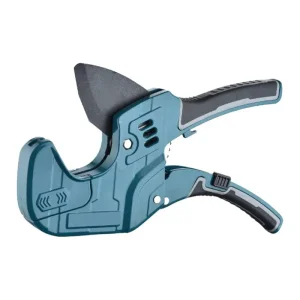
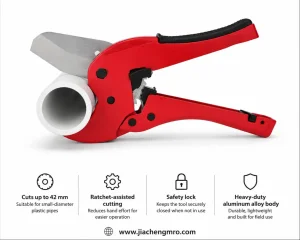
The ratcheting drive utilizes high-grade structural carbon steel pawls paired with precision-milled arc gear teeth. This step-by-step advance mechanism amplifies hand grip input by up to 1200%, transferring force through an optimized leverage curve that prevents pipe collapse during initial blade penetration.
SK5 / 8Cr13MoV Blade Metallurgy
Factory blades are forged from premium high-carbon tool steels (SK5, 65Mn, or 8Cr13MoV) subjected to computer-controlled vacuum heat treatment. Achieving a Rockwell hardness of HRC 54-58, blades feature double-bevel edge geometry to ensure zero burr creation and exceptional wear resistance.
Die-Cast ADC12 Aluminum Chassis
To resist torsional flexing during heavy-wall schedule 80 PVC cuts, handles and bodies are cast from aerospace-grade ADC12 aluminum alloy. Precision powder coating and anti-slip dipping treatments ensure ergonomic stability in high-moisture work sites.
Information Gain Engineering Note: Unlike cheap stamped-steel cutters that flex under load causing angled cuts, industrial ratchet cutters utilize hardened guide-pins and dual-pivot drive link plates. This maintains absolute blade alignment perpendicular to the pipe axis (within ±0.3 degrees).
| Cutter Model Category | Pipe Outer Diameter Range | Compatible Pipe Polymers | Blade Material & Hardness | Body Material & Finish | Primary Industrial Standard |
|---|---|---|---|---|---|
| Compact Precision (e.g. 36mm) | O.D. 3mm – 36mm (1-3/8") | PEX-a/b/c, PB, Small PPR | SK5 High Carbon / HRC 56±2 | ADC12 Aluminum / Electrostatic Coating | ASTM F1807 / DIN 16892 |
| Standard Commercial (e.g. 42mm) | O.D. 3mm – 42mm (1-5/8") | Schedule 40/80 PVC, PPR, CPVC, PE | 8Cr13MoV Stainless Alloy / HRC 57±1 | High-Pressure Die-Cast Alloy / Dipped Grip | ISO 15874 / BS EN 12201 |
| Heavy-Duty Industrial (e.g. 63mm-75mm) | O.D. 16mm – 75mm (3") | Large-bore PPR, HDPE, Multilayer PEX-AL | 65Mn Spring Steel + PTFE Coating / HRC 55±2 | Reinforced Structural Alloy / Anodized Finish | DIN 8077/8078 / GB/T 18742 |
Industry Trends & Technology Roadmap (2025–2030)
The manufacturing sector for ratcheting pipe cutters is experiencing rapid innovation driven by smart manufacturing techniques, specialized polymer evolution, and jobsite ergonomics. Wholesale buyers and factory sourcing agents must align their procurement roadmaps with several key industry shifts:
1. Advanced Surface Coatings
Transitioning from bare polished steel to Fluoropolymer (PTFE) and Titanium Nitride (TiN) nano-coatings. These low-friction surface treatments reduce cutting torque resistance by up to 25%, while preventing adhesive resin buildup when cutting co-extruded multilayer pipe systems.
2. Rapid Tool-Less Blade Exchange
Modern jobsite productivity requires zero downtime. Next-generation OEM designs incorporate quick-release push-pin mechanisms allowing field technicians to replace worn blades in under 15 seconds without requiring hex keys or screwdrivers.
3. Cold-Weather Polymer Optimization
Standard PVC becomes extremely brittle at sub-zero temperatures (< 0°C), making traditional wedge-style cutters prone to shattering pipes. Cutting geometries are evolving toward micro-thin V-shaped edge profiles that shear rather than wedge during cut cycles.
Localized Application Scenarios & Macro Solutions
A major consideration for international B2B importers is tailoring inventory selection to localized regional plumbing standards and installation environments. Below are macro solutions designed by leading China OEM suppliers to address real-world jobsite challenges:
Scenario A: High-Density Residential Retrofits (Tight Space Engineering)
In compact European and Asian apartment renovations, plumbing pipes are routed inside narrow wall cavities and under subfloors. Standard long-handled cutters cannot swing through their full ratcheting arc. Compact ratcheting tools (such as 36mm and narrow-profile 42mm models) feature short-pitch ratchet gearing, requiring an operating arc angle of only 15 to 20 degrees, allowing technicians to make square cuts where space is strictly limited.
Scenario B: Off-Grid Industrial Infrastructure & Gas Fusion Integration
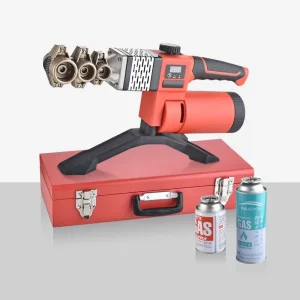
In rural utility expansions and heavy civil projects, electrical power is frequently unavailable. Cutting large-diameter PPR or HDPE pipes (50mm to 75mm O.D.) requires heavy-duty ratcheting pipe cutters capable of preparing pristine pipe ends for subsequent thermal socket fusion welding. Paired with portable 1.4KW gas-powered fusion welders, utility contractors obtain a complete off-grid pipe joining solution compliant with high-pressure gas and water transport codes.
Scenario C: High-Frequency Commercial Plumbing Construction
On commercial high-rise projects where workers perform thousands of cuts per day, hand strain and repetitive motion injuries lead to costly delays. OEM ratcheting tools equipped with automatic spring-loaded handle release mechanisms and anti-slip dipped rubber handles maximize cycle speed while reducing hand muscle strain by up to 40% compared to manual shears.
B2B Procurement & Supplier Qualification Audit
A structured framework for tool distributors, brand buyers, and retail importers auditing China manufacturing partners.
Factory Audit Checklist
Verify that your supplier operates in-house CNC machining, vacuum heat treatment, and automated assembly lines. ISO9001 quality system certification ensures rigorous incoming material inspection for raw aluminum and steel ingots.
Endurance & Fatigue Testing
Tier-1 factories validate cutter durability by executing accelerated lifetime tests—subjecting cutters to over 10,000 continuous cuts on max-diameter Schedule 80 PVC without blade chipping or ratchet pawl slippage.
Custom Branding & OEM Packaging
Professional suppliers offer full ODM services including custom handle colors (Pantone matching), laser-etched brand logos, blister pack/color box design, and private-label Barcoding for international retail networks.
Factory Direct Solutions & Specialized Tooling
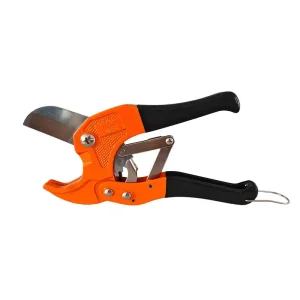
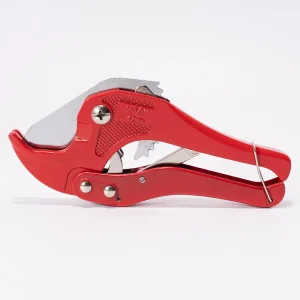
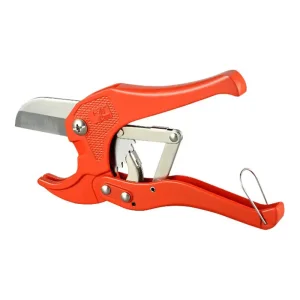
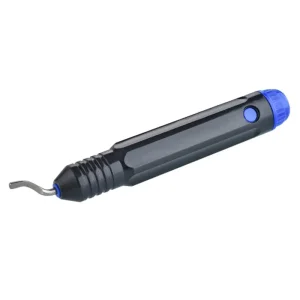
Explore our full line of professional-grade cutters, deburring tools, and pipe joining hardware.
Frequently Asked Questions by Importers & Master Plumbers
1. Why are ratcheting PVC cutters preferred over standard single-stroke shears for commercial piping?
Standard single-stroke shears rely entirely on direct hand pressure, which causes structural pipe wall flattening, ovality deformation, and high physical fatigue during continuous use. Ratcheting PVC cutters employ a step-down gear kinematics system that multiplies operator hand force by up to 12:1. This permits clean, square cuts on schedule 80 PVC, PPR, and thick-walled plastic pipes without crushing or cracking the pipe profile.
2. What blade material provides the best balance of edge longevity and chip resistance?
High-carbon SK5 steel and 8Cr13MoV stainless alloy treated to HRC 54–58 represent the industry gold standard. SK5 offers superior edge sharpness for clean cuts on soft polymers like PEX and PE. For harsh construction environments where moisture and chemical exposure occur, 8Cr13MoV stainless steel or PTFE-coated blades provide maximum corrosion resistance and prevent resin binding.
3. How do factory suppliers prevent ratcheting mechanism failure under heavy loads?
Quality manufacturers utilize heat-treated structural steel pawls and CNC-milled ratchet gears rather than stamped powder metal components. Furthermore, die-cast ADC12 aluminum bodies feature internal ribbing to prevent frame flexing under high torque, ensuring that ratchet teeth remain fully engaged throughout the cutting cycle.
4. What are the typical Minimum Order Quantities (MOQ) and customization lead times for OEM/ODM orders?
For standard models with custom laser logo branding and customized handle color dipping, typical factory MOQs range from 500 to 1,000 units per model. Custom blister packaging or bespoke die-cast body modifications usually require an initial lot of 2,000 units. Standard production lead times average 25 to 35 days following sample approval.
5. Can ratcheting PVC cutters be used on metal or wire-reinforced piping?
No. Ratcheting plastic pipe cutters are specifically engineered with micro-bevel edge geometry optimized for synthetic polymers (PVC, PPR, PEX, CPVC, PE, PVDF). Attempting to cut metallic tubing (such as copper, steel, or aluminum conduit) will instantly chip or roll the hardened blade edge. Metallic pipes require rotational wheel tube cutters or specialized deburring tools.
6. How does deburring after cutting affect pipe connection integrity?
Even high-precision ratcheting cutters leave slight edge feathering or subtle external ridges. Using an M2 HSS deburring tool or pipe calibrator after cutting ensures a clean outer chamfer. This prevents rubber O-ring displacement in press-fittings and guarantees complete insertion depth during solvent cement or thermal socket fusion welding.