Featured OEM Tool Catalog & Precision Welding Systems
Factory-direct industrial grade pipe cutting, deburring, and thermofusion welding machinery configured for international distributor private labeling and rigorous site deployments.
1. Global Enterprise Procurement Demand for Heating Pipe Fusion Systems
Analyzing macroeconomic shifts, infrastructure scaling, and procurement criteria across international HVAC, district heating, and municipal polyolefin piping networks.
The global transition from metallic piping infrastructure (galvanized steel, copper, iron) to high-performance thermoplastic networks—specifically PPR (Polypropylene Random Copolymer), PE-RT (Polyethylene of Raised Temperature Resistance), and HDPE (High-Density Polyethylene)—has fundamentally reshaped global municipal and industrial heating requirements. Thermal socket fusion and butt fusion welding machines serve as the critical nexus in ensuring structural integrity across these networks.
District Heating Expansion
Rapid urbanization across Eastern Europe, Central Asia, and East Asia demands high-density PE-RT and PPR heating pipe fusion equipment operating at stable 260°C thresholds to ensure 50+ year zero-leak infrastructure lifespans.
Off-Grid Jobsite Realities
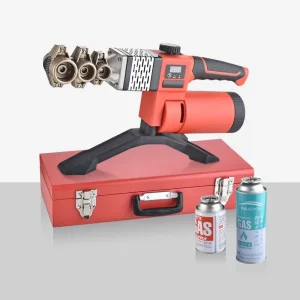
Conventional electric socket fusion tools require heavy diesel generators or long extension cables that cause voltage drops, compromising heating element stability. Mobile gas-powered 1.4KW fusion welders solve off-grid power bottlenecks.
Compliance & Liability Risks
Enterprise procurement departments must satisfy strict regional building codes (such as DVS 2207, ISO 12176, and CE standards). Partnering with an ISO9001 certified OEM manufacturer eliminates legal liability and supply chain friction.
Manufacturing Benchmarks & Quality Indicators
Quantifiable operational metrics behind Yuyao Jiacheng Tools Industry & Trade Co., Ltd.
2. Macro-Industry Solutions: Polymer Fusion Thermodynamics & Structural Integrity
Understanding the micro-molecular dynamics of polyolefin socket fusion to prevent catastrophic pipeline micro-fissures and thermal joint degradation.
The Physics of Socket Thermofusion
Polypropylene Random Copolymer (PPR) welding relies on controlled molecular interdiffusion across the melt boundary. When heating sockets reach precisely 260°C (±5°C), the crystalline polymer structures uncoil into a viscoelastic state. Inserting the pipe end into the heated socket matrix creates an inter-penetrating polymer network (IPN).
Improper temperature control results in either thermal degradation (overheating above 280°C oxidizes polymer chains, rendering the joint brittle) or cold-welding (underheating below 245°C prevents full molecular chain entanglements, causing pressure blow-outs under hot water load cycles).
Systemic Pipe Preparation Integration
A fusion joint is only as strong as its preliminary cutting and deburring preparation. Utilizing sub-standard cutting tools leaves jagged edges, burrs, or out-of-round pipe geometries that trap air bubbles inside the fusion zone.
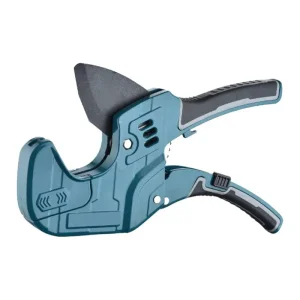
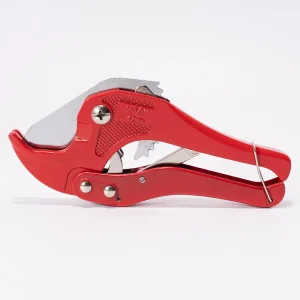
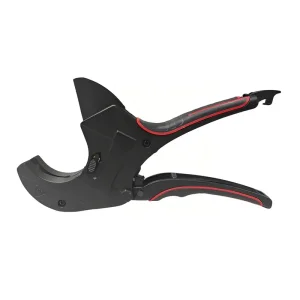
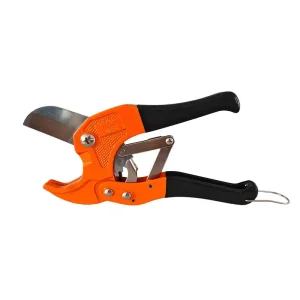
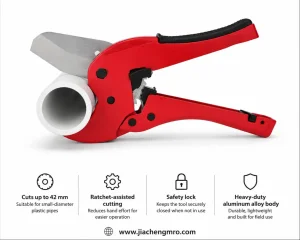
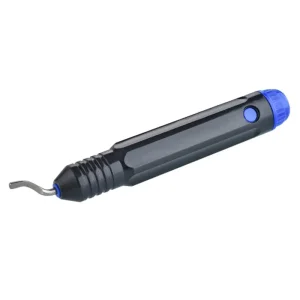
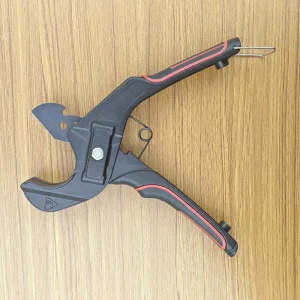
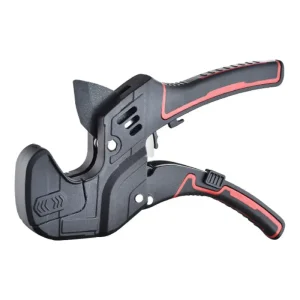
Integrating precision ratchet pipe cutters (up to 42mm–75mm), M2 HSS deburring tools, and 3-in-1 pipe calibrators ensures absolute squareness, zero inner burr interference, and optimal insertion depth before thermal application.
| Welding Technology | Target Pipe Materials | Optimal Size Range | Power Source / Heat Input | Field Mobility Rating | Primary Industry Application |
|---|---|---|---|---|---|
| Gas-Powered Socket Fusion | PPR, PE, PB, PE-RT | 20mm – 32mm (Extruded sockets) | Liquid Gas Cartridge / 1.4KW Hydrocarbon Combustion | Maximum (100% Cordless) | Off-grid residential, remote HVAC, high-altitude jobsites |
| Electric Matrix Socket Welder | PPR, PE-RT, HDPE | 20mm – 160mm | 110V/220V Electric Heating Plate (600W – 1500W) | Moderate (Requires Generator / AC) | Standard indoor plumbing, commercial building risers |
| Hydraulic Butt Fusion Machine | HDPE, PP, PVDF | 63mm – 1200mm+ | Hydraulic Station + Electric Heating Mirror | Low (Heavy Equipment) | Municipal water mains, gas distribution trunklines |
| Electrofusion Processor | HDPE, PE100, PE80 | 20mm – 630mm | Electric Barcode Controlled Direct Resistance Current | Moderate (High Machine Weight) | High-pressure hazardous gas and chemical transport lines |
3. Technical Architecture & Engineering Innovation Roadmap
How Jiacheng Tools integrates thermodynamic precision, dual-layer PTFE matrices, and cordless hydrocarbon heating systems for high-performance OEMs.
1.4KW Gas-Powered Thermofusion Engine
Eliminating reliance on electrical cables or volatile lithium battery packs, our flagship 1.4KW gas-powered fusion welder delivers fast thermal ramp-up (reaching operational 260°C in under 3 minutes) with continuous temperature regulation regardless of ambient sub-zero conditions.
Dual-Layer Japanese PTFE Die Matrix
Socket die longevity is determined by coating durability. Our custom OEM heating dies utilize a high-density, multi-layer PTFE fluoropolymer coating that resists molten polymer adhesion across 4,000+ fusion cycles, preventing pipe wall scraping and sticking.
Ergonomic Mechanical Advantage Cutters
Complementing our thermal fusion welders, our heavy-duty ratchet cutter range features heat-treated SK5/M2 high-carbon steel blades engineered with progressive gear ratios. This reduces handle force requirement by 35% during 63mm/75mm HDPE cuts.
4. Global Commercial & Industrial Application Scenarios
Deploying OEM heating pipe fusion welding technology across diverse sector requirements worldwide.
A. Residential Hydronic Floor & Radiator Heating
In cold climate zones across Europe and Northern Asia, PE-RT and PPR pipes are laid in continuous underfloor loops. A single cold-welded joint inside a concrete slab can cause catastrophic property damage. Our micro-calibrated 20-32mm fusion welders ensure 100% seam fusion before screed pouring.
B. Commercial Chilled & Hot Water HVAC Risers
Multi-story commercial complexes utilize large-diameter PPR-CT piping for HVAC fluid transfer. Precision pipe cutting up to 75mm combined with stable socket heating plate thermal dissipation prevents internal lumen reduction (bead overflow), keeping system hydraulic resistance low.
C. Off-Grid Agricultural Irrigation & Utility Lines
Agricultural drip networks and rural water supply projects often span vast remote zones where mains power is unavailable. The portable 1.4KW gas-powered fusion welder allows field technicians to complete inline pipe repairs without towing heavy diesel generators.
D. Industrial Chemical & Compressed Air Pipework
Industrial facilities utilize specialized polyolefin piping to resist corrosive media. Clean, burr-free cuts made with M2 HSS deburring tools and precision ratchet cutters prevent chemical entrapment and maintain laminar fluid movement inside processing plants.
5. Enterprise Localization Support & Regulatory Compliance
Assuring international importers, hardware distributors, and brand owners of complete compliance, custom branding, and quality control execution.
International Certification
Our production facilities operate under ISO9001 quality management systems. Key products, including our gas-powered fusion welding series, carry SGS and CE certifications, streamlining entry into EU and North American retail channels.
Comprehensive OEM/ODM Service
We provide end-to-end customization: custom color dipping handles, laser-etched brand logos, custom BMC (Blow Mold Case) tool boxes, bespoke voltage wiring (110V/230V), and specialized socket size pairings according to regional market standards.
Rigorous Inspection Protocol
Every welding machine and cutting tool undergoes 100% factory inspection before dispatch. Heat plates undergo 48-hour thermal stability testing, while cutter blades undergo hardness (HRC 54–58) and clean-cut endurance testing.
6. Frequently Asked Questions (Technical & Procurement Q&A)
Direct answers from our senior engineering team to common queries raised by international buyers and project managers.
Why choose a gas-powered PPR fusion welder over a lithium battery-powered model?
Lithium-battery welding machines suffer from continuous high-amp power draw, resulting in rapid battery exhaustion (often lasting only 15–20 fusion joints per charge) and significant weight overhead. A 1.4KW gas-powered fusion welder provides constant heat output for hours via inexpensive, lightweight gas cartridges, making it far superior for high-volume off-grid jobs.
What is the ideal heating temperature for PPR socket fusion welding?
The standardized temperature for PPR socket thermofusion is 260°C (±5°C), as mandated by DVS 2207 standards. Lower temperatures prevent complete polymer chain fusion, leading to cold joints, whereas temperatures exceeding 280°C cause polymer oxidation, material degradation, and bead wall collapse inside the pipe fitting.
How does a deburring tool impact the longevity of a fusion welded joint?
When plastic or multilayer pipes are cut, micro-burrs and uneven edges form on the inner and outer circumferences. Outer burrs scrape off the non-stick PTFE coating of heating dies, while inner burrs create turbulence and trap air bubbles during insertion. Using an M2 HSS deburring tool creates a clean chamfer that ensures uniform melt pressure.
What Minimum Order Quantities (MOQ) and lead times apply for OEM branding?
For custom logo laser engraving and standard color dipping, our typical OEM MOQ starts at 500–1,000 units per item. Custom BMC plastic cases and specialized packaging colors require an MOQ of 1,000 units. Standard sample production requires 3–5 days, while mass order lead time averages 25–30 days.
How often should heating sockets/dies be replaced during continuous operation?
With high-grade Japanese PTFE dual-layer coatings, Jiacheng heating dies typically maintain non-stick performance for over 4,000 fusion cycles under clean site conditions. Dies should be replaced immediately if the PTFE coating shows visible scratches that expose the raw aluminum, as exposed metal causes polymer drag and uneven heating.
Can Jiacheng pipe cutters handle multilayer PEX-AL-PEX pipe without crushing the aluminum core?
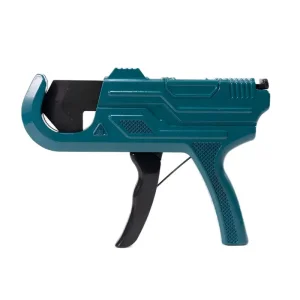
Yes. Our specialized 36mm and 50mm multi-layer pipe cutters are engineered with curved v-shaped jaw geometry and high-hardness SK5/M2 precision blades that support the outer pipe wall during cutting. This prevents ovalization and keeps the aluminum core intact for immediate pipe calibration.
Advanced OEM Pipe Cutting & Preparation Equipment
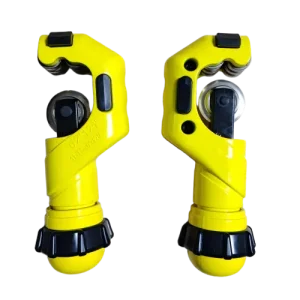
Complete your catalog offering with heavy-duty adjustable cutters, copper tube tools, and professional pipe deburring systems.