
Precision Pipe Cutting & Deburring Solutions
Industrial-grade hand tools engineered for flawless end-face preparation prior to poly pipe fusion welding.
The Macro Evolution of Thermoplastic Pipeline Joining Technologies
Analyzing global material shifts toward High-Density Polyethylene (HDPE), Polypropylene Random Copolymer (PPR), and Polybutylene (PB) in modern civil infrastructure and industrial fluid handling.
Shift from Mechanical Mechanical Joining to Homogeneous Molecular Fusion
Global piping engineering has experienced a paradigm shift away from traditional threaded, flanged, or solvent-cemented joints toward thermo-fusion welding. Modern poly pipe fusion welders create continuous, monolithic piping systems where joint interfaces match or exceed the parent pipe's yield strength and pressure rating (SDR standard).
This transition is driven by the operational necessity to eliminate leak paths in critical municipal distribution, gas supply networks, and aggressive industrial chemical transport systems.
Microprocessor-Driven Thermal Precision (PID Control)
Legacy thermal fusion devices suffered from thermal hysteresis, leading to degradation of polyolefin polymer chains (crystallite melting point overshoot) or inadequate interfacial melting. State-of-the-art ODM poly pipe fusion machines incorporate digital Proportional-Integral-Derivative (PID) controllers coupled with solid-state relays (SSR).
This architecture guarantees thermal stability within ±1°C across working ambient temperatures ranging from -10°C to +45°C, complying strictly with DVS 2207 and ISO 12176 standards.
Global Procurement Benchmarks for Poly Pipe Fusion Machinery
How tier-one EPC contractors, municipal utility boards, and multinational MRO distributors audit and select ODM fusion welding manufacturing partners.
Rigorous Certification & Safety Protocols
International procurement teams prioritize manufacturing partners holding valid ISO9001 quality management systems alongside product-level CE (LVD/EMC directives) and SGS validation. Electrical insulation parameters, dielectric breakdown resistance, and ground fault safety are critical non-negotiables for high-humidity jobsites.
Ergonomics & Off-Grid Versatility
Field labor costs demand equipment optimized for fast cycle times and minimal physical fatigue. Modern procurement trends emphasize lightweight cast-aluminum heating plates, ergonomic rubberized grips, dual temperature indicators, and off-grid power solutions—such as gas-powered or high-capacity lithium battery fusion devices.
ODM Customization & Supply Chain Agility
Private label buyers require deep ODM flexibility: custom heating die socket dimensions (JIS, ANSI, DIN), tailored voltage configurations (110V/220V/dual voltage), customized tool kit cases, and brand-specific thermal housing color schemes engineered to strengthen local distributor equity.
China Industry 4.0: Modern Supply Chain Resilience & Technological Superiority
Why Yuyao, Zhejiang has consolidated its position as the world's premier center for precision plumbing tools and automated poly fusion machine manufacturing.
Automated Die-Casting & CNC Machining Ecosystems
Leading Chinese factories, such as Yuyao Jiacheng Tools Industry and Trade Co., Ltd., leverage multi-axis automated CNC machine centers to craft high-density aluminum alloy heating matrix plates and die heads. Precision CNC machining eliminates surface micro-porosity, ensuring uniform heat distribution across the entire socket welding interface.
Integrated Manufacturing Execution Systems (MES) track material batches from raw ingot composition through to final PTFE (Teflon) spray-coating thickness validation.
Industrial Cluster Synergies & Risk Mitigation
The concentration of specialized upstream component vendors—including high-purity heating elements, custom-molded ergonomic housings, digital thermostats, and precision-cut tool steel blades—provides unmatched supply chain elasticity. Orders can scale rapidly from batch prototyping to tens of thousands of units without lead-time inflation.
Furthermore, strategic access to Ningbo and Shanghai maritime ports guarantees frictionless global logistics execution and minimized transit overhead.
| Fusion System Parameter | Standard Market Entry Level | Jiacheng Industry 4.0 ODM Specification | Operational Impact |
|---|---|---|---|
| Heating Element Tech | Single mica plate heating wire | Dual-element high-purity aluminum core (PTC) | 35% faster heat-up time; zero cold spots |
| Socket Matrix Coating | Standard single-layer PTFE coating | Dual-layer Japanese Daikin Industrial Grade PTFE | Prevents polymer sticking; 3x longer wear life |
| Temperature Regulation | Basic bimetallic mechanical thermostat | Microprocessor PID controller (Solid State Relay) | Maintains exact melt temp (±1°C); prevents pipe burnout |
| Handle & Housing Construction | Recycled ABS plastic | High-impact virgin reinforced Nylon (PA66-GF30) | Resists 2-meter drop test on freezing job sites |
| Power Source Versatility | Standard AC 220V only | Multi-Voltage AC / Gas-Powered Cordless Options | Uninterrupted operation in remote off-grid locations |
Localized Application Scenarios & Engineering Field Guidelines
From high-density urban residential plumbing to remote mining slurry conduits, discover how targeted poly pipe welding tools deliver zero-leak infrastructure.
1. Residential PPR Plumbing & Heating Systems
In domestic hot and cold potable water networks (20mm to 63mm PPR pipe), rapid socket fusion tools are deployed to assemble compact riser manifolds and underfloor radiant heat loops.
Key Requirement: Rapid socket insertion depth control and zero smoke generation to protect indoor air quality during indoor renovation projects.
2. Agricultural & Irrigation Infrastructure
Large-scale agricultural irrigation and drip distribution networks rely heavily on High-Density Polyethylene (HDPE) lines up to 110mm and beyond, often installed across vast rural landscapes.
Key Requirement: Gas-powered fusion welders eliminate dependence on heavy, cumbersome diesel generators in remote fields, maximizing installation mobility.
3. Industrial Chemical & Mining Fluid Lines
Industrial processing plants utilize PVDF and heavy-wall PE pipes to convey corrosive acids, alkalis, and abrasive tailings slurries under severe pressure continuous cycles.
Key Requirement: Complete weld bead geometry control via computerized hydraulic butt fusion machinery, ensuring zero internal obstruction or stress concentration points.
Frequently Asked Sourcing & Engineering Questions
Comprehensive answers to essential technical, quality assurance, and ODM contract manufacturing inquiries.
Socket Fusion involves simultaneously heating the outer wall of a pipe end and the inner wall of a fitting socket using a direct thermal die (socket welder) heated to ~260°C (for PPR/PE). Once the material reaches a molten state, the components are joined manually or mechanically without rotation. This is highly cost-effective for pipe diameters up to 110mm.
Electrofusion utilizes specialized fittings embedded with internal electrical heating coils. An automated electrofusion processor connects to the fitting terminals, applying electrical power to melt the interface. Electrofusion is typically specified for large-diameter HDPE gas/water mains or tight trench repair applications where physical access for direct heat plates is restricted.
Failing to perform a clean, square (90-degree) cut causes uneven insertion depth within the heating socket, creating localized voids or polymer buildup that restricts fluid flow. Furthermore, burrs or jagged plastic edges trap air and moisture during insertion, causing microscopic voids and oxidation within the weld pool.
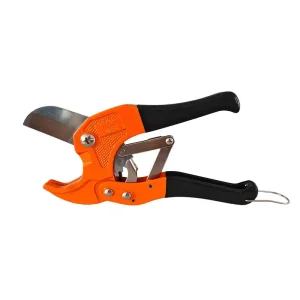
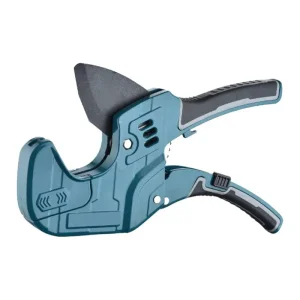
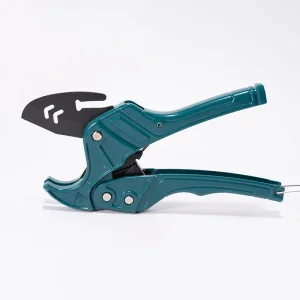
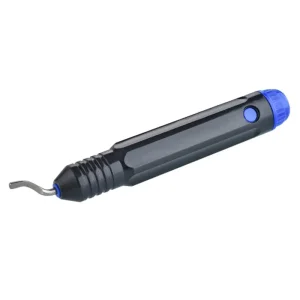
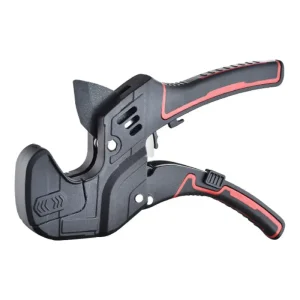
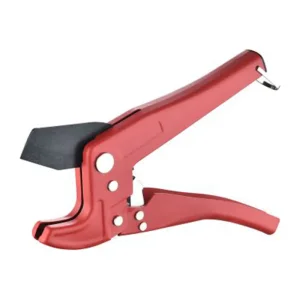
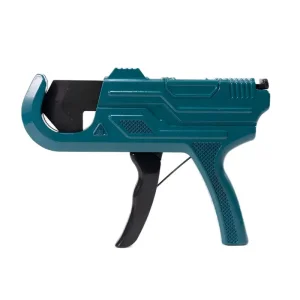
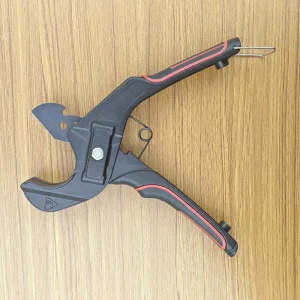
Utilizing high-precision ratchet pipe cutters (such as the JC-PC-22 63mm or 42mm series) combined with M2 HSS deburring tools guarantees clean end-faces, uniform thermal absorption, and complete structural homoeogeneity across the joint interface.
As a specialized OEM/ODM manufacturer, Yuyao Jiacheng Tools configures poly pipe fusion welders according to destination electrical compliance frameworks:
- North America: 110V/120V 60Hz with NEMA 5-15P grounded plugs and UL-compliant heating elements.
- Europe & International: 220V/230V 50Hz with VDE-certified Schuko plugs, CE marking, and LVD insulation safety compliance.
- UK & Commonwealth: 110V site transformers (Yellow BS EN 60309 plugs) or 240V BS 1363 fused plugs.
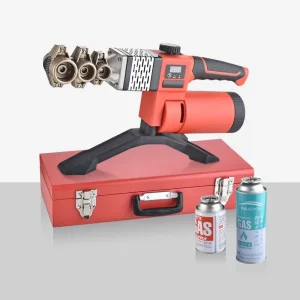
- Off-Grid Solution: Proprietary 1.4KW Gas-Powered PPR Fusion Welders, completely bypassing electrical requirements.
Quality assurance follows strict ISO9001 protocols throughout four distinct stages:
- Incoming Component Inspection (IQC): Testing heater wire purity, thermistor accuracy, and aluminum alloy die cast density via X-ray analysis.
- In-Process Testing (IPQC): Continuous monitoring of PTFE coating thickness (target: 25-35 microns) and thermal mapping of heating plates using FLIR infrared sensors.
- End-of-Line Testing (FQC): 100% high-voltage dielectric insulation withstand testing, ground continuity verification, and 4-hour burn-in stress testing.
- Pre-Shipment Audit (OQC): Hydrostatic destructive burst pressure testing on welded PPR/HDPE pipe samples to confirm 100% joint integrity.
Yes. We offer complete OEM/ODM private-label integration. Services include laser-engraved brand logos on heating plate housings, custom handle dipping colors (pantone matched), custom steel carry case powder-coating, localized user instruction manuals, and retail-ready color box design adhering to international barcode and shipping standards.
Specialized Fusion Machinery & Cutting Instruments
High-performance fusion welding machines and compact cutting tools for high-frequency plumbing installation contractors.
Partner with China's Premier ODM Poly Pipe Fusion Welder Manufacturer
Streamline your sourcing cycle with direct-from-factory pricing, guaranteed ISO9001/CE/SGS compliance, and tailored OEM private labeling for global distribution networks.