Professional Pipe Cutting & Fusion Equipment
Factory-direct OEM/ODM solutions engineered for zero-defect installation compliance.
Global Industrial & Commercial Landscape of PPR Pipe Welding
Polypropylene Random Copolymer (PPR-C) piping systems have rapidly surpassed traditional metallic piping (such as copper and galvanized steel) across residential plumbing, industrial fluid transport, and modern HVAC hydronic networks. Driven by non-corrosive material properties, high temperature endurance (up to 95°C continuous operation), and an operational lifecycle exceeding 50 years, the global market demand for precise PPR welding machines is accelerating at a compound annual growth rate (CAGR) of 6.8%.
Unlike solvent welding or mechanical compression fittings, PPR relies entirely on homogeneous socket fusion. When executed with high-precision thermal tools, the interface between pipe and fitting disappears, forming a single continuous polymer structure. Consequently, the integrity of entire municipal water grids, commercial high-rise plumbing, and industrial chemical transportation rests directly on the thermal stability, socket geometry, and heating matrix uniformities of the fusion equipment.
Physics of Polymer Socket Fusion: Information Gain & Parameter Precision
Achieving a zero-leak joint requires rigorous adherence to thermodynamic physics. Sourcing teams must evaluate PPR fusion welders beyond basic heating capability. Key engineering factors determine joint reliability on site:
Microprocessor Temperature Regulation
Standard thermostatic welders experience thermal swings of ±15°C, risking material degradation (overheating above 270°C breaks polymer chains) or cold joints (under 250°C prevents intercrystallite diffusion). Advanced China manufacturers like Jiacheng integrate PID micro-controllers to hold 260°C within a tight ±5°C window even under outdoor wind loading.
Die Matrix Teflon (PTFE) Coating Standard
PPR residue sticking to socket dies causes thermal hotspots and localized voids during joint assembly. Premium China suppliers utilize dual-layer Daikin or DuPont Japanese-grade PTFE matrix coatings (minimum 30μm depth), enduring 3,000+ heating cycles without surface erosion or polymer drag.
Bore-Restriction Avoidance Engineering
Excessive insertion depth or uneven heating leads to internal weld bead buildup, constricting water flow by up to 40%. China precision tooling includes depth-calibrated socket collars and mechanical stops to guarantee full fusion depth without compromising inner diameter hydraulics.
Why China (Yuyao Cluster) Dominates Global Plumbing Tool Manufacturing
Global distributors, hardware brands, and MEP procurement managers consistently choose Chinese manufacturers for PPR welding machines and pipe preparation tools. The core competitive advantage stems from specialized industrial ecosystems like the Yuyao Hardware Cluster in Zhejiang Province:
Vertical Industrial Integration
Within a 15-kilometer radius of Yuyao Jiacheng’s 2,667 m² factory, every component—from high-purity aluminum heating plate die-casting, custom electric heating elements, CNC precision machining of die heads, to injection-molded ergonomic housings—is sourced in hours rather than weeks. This hyper-localized supply chain dramatically lowers lead times and bill-of-materials (BOM) costs.
Automated Quality Assurance & Testing
Equipped with over 40 sets of modern CNC machines, automatic coating lines, and computerized thermal calibration stations, leading Chinese factories ensure each unit undergoes 100% full-load electrical insulation testing, thermal gradient analysis, and pressure-drop verification prior to export, keeping defect rates strictly below 0.5%.
PPR Pipe Fusion Machine Category & Performance Matrix
Compare key operational specifications across different welder architectures to select the ideal model for your distribution market or jobsite environment:
| Welder Type / Architecture | Power Source / Capacity | Heating Range (mm) | Temp Control Accuracy | Primary Application Scenario | Key Advantage |
|---|---|---|---|---|---|
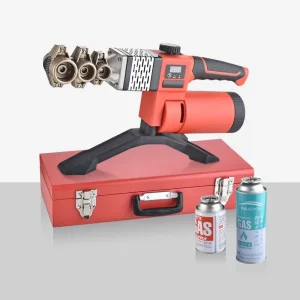
| Gas-Powered Fusion Welder Patented Innovation | 1.4 kW Butane / Isobutane Gas | 20mm – 32mm | Thermostatic Gas Valve Control | Off-grid jobsites, remote infrastructure, emergency repairs | 100% Cordless, zero electric generator required |
| Digital Microprocessor Welder | 800W – 1500W AC Electric | 20mm – 63mm | PID Digital LCD Control (±2°C) | High-rise commercial residential plumbing, strict inspection jobs | Real-time temp display, programmable heating profiles |
| Dual-Element Manual Welder | 1500W (750W + 750W Dual Switches) | 20mm – 110mm | Capillary Thermostat (±5°C) | General contractor plumbing kits, high-duty construction | High heat capacity, dual power options for quick heating |
| Benchtop Industrial Fusion Unit | 2000W – 3000W Heavy Electrical | 75mm – 160mm | Electronic Closed-Loop (±3°C) | Large diameter municipal water headers & industrial lines | Mechanical alignment sled to prevent pipe tilt during fusion |
Global Field Applications & Cordless Gas Fusion Innovations
The Off-Grid Challenge in Emerging Markets
In many developing infrastructure zones across Latin America, Southeast Asia, and Sub-Saharan Africa, reliable 220V grid electricity is unavailable on early-stage job sites. Contractors historically relied on noisy, heavy diesel generators just to run a single 800W socket welder.
To solve this critical pain point, Chinese R&D engineering produced the 1.4KW Gas-Powered PPR Fusion Welder. Utilizing inexpensive, standard gas cartridges, this handheld unit reaches the required 260°C operating temperature in under 3 minutes, giving plumbers complete freedom to execute leak-free joins in trenches, remote rural water schemes, or high-level scaffolding without extension cords.
HVAC Hydronic & Cleanroom Environments
In North American and European building retrofits, PPR-CT (Beta-crystalline PPR) and multilayer fiber-reinforced PPR pipes are increasingly specified for chilled water cooling loops and radiantly heated floors.
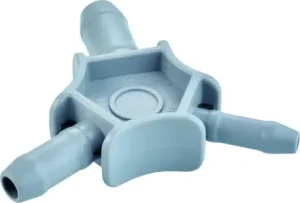
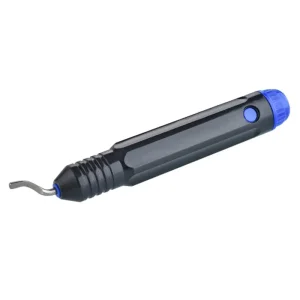
These advanced polymer structures demand flawless temperature uniformity across the heating matrix. Paired with Jiacheng’s high-precision 3-in-1 Pipe Calibrators and M2 HSS Deburring Tools, installers maintain perfect pipe roundness and chamfer angles prior to heating, preventing O-ring displacement and ensuring uniform fusion melt across all wall thicknesses.
B2B Buyer Qualification Checklist: Evaluating China PPR Machine Suppliers
When conducting supplier audits and qualifying OEM/ODM vendors for international tool distribution, professional buyers must inspect five mandatory quality control pillars:
1. ISO9001 & SGS/CE Certification
Ensure the factory holds active ISO9001 management certification and full CE/SGS safety compliance documentation for low-voltage electric safety, electromagnetic compatibility (EMC), and pressurized gas appliances.
2. Destructive Weld Testing
Qualified suppliers conduct regular hydrostatic burst pressure testing (according to ISO 1167) and tensile elongation weld breaks to prove that the fused joint consistently withstands higher pressure than the pipe itself.
3. Custom OEM Capabilities
Verify private-label support: custom body color powder coatings, laser-engraved brand logos, customized steel carry cases, specialized socket sizes (e.g., IPS vs metric), and tailored user manuals.
PPR Welding & Sourcing FAQ (Frequently Asked Questions)
What is the standard heating temperature for PPR socket fusion machines?
The internationally standardized temperature for PPR socket thermal fusion is 260°C (500°F), according to DVS 2207-11 and DIN 16962. A high-quality welder must maintain this temperature within a tight tolerance of 255°C to 265°C. Lower temperatures cause incomplete molecular diffusion (weak joints), while higher temperatures break down the polypropylene polymer chains, creating structural embrittlement and flow restrictions.
How does a gas-powered PPR welding machine operate safely without electricity?
Gas-powered welders utilize a internal micro-burner powered by standard butane or propane gas canisters. A precise thermal regulator controls gas flow to heat a high-conductivity copper-aluminum core, transferring steady heat to the die sockets. Gas units are built with piezoelectric ignition, flameout safety protection, and thermal heat shields to ensure 100% operational safety on active jobsites.
Why is clean pipe cutting essential before thermal socket fusion?
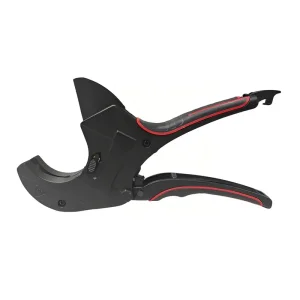
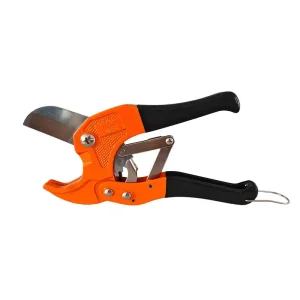
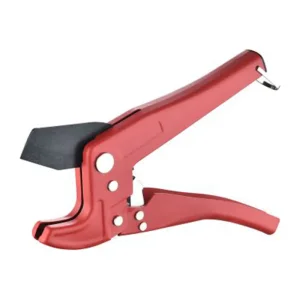
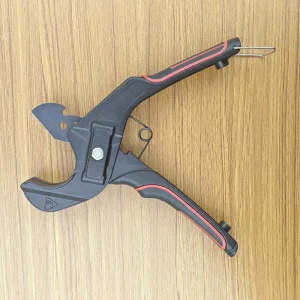
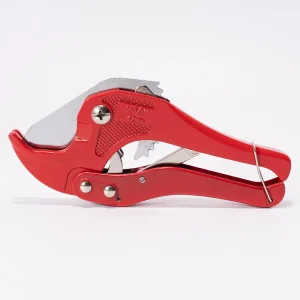
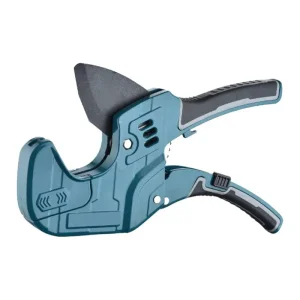
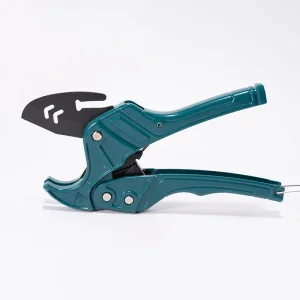
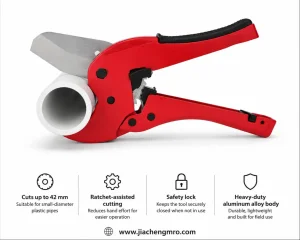
Uneven, burred, or angled pipe cuts lead to non-uniform insertion depth inside the heating socket socket matrix. This causes localized cold spots or air traps, leading to joint leaks under pressure testing. Utilizing precision ratchet PVC/PPR pipe cutters (like Jiacheng 42mm or 63mm models) ensures an exact 90-degree square cut without crushing or ovalizing the pipe wall.
What minimum order quantities (MOQ) and OEM options are typical for China factories?
For standard stock factory models, MOQ starts as low as 100–300 units. For full OEM customized orders (custom handle color dipping, laser logo printing, branded steel toolboxes, customized plug formats for UK/US/EU grids), typical MOQs range from 500 to 1,000 sets per production run with lead times of 15 to 25 days.
How do Teflon-coated socket dies affect machine longevity?
During fusion, molten polypropylene directly contacts the socket surface. High-grade double-layer Teflon (PTFE) prevents molten plastic from bonding to the metal die. Quality dies permit thousands of clean heating cycles without sticking or smoking, preserving both the tool's performance and the purity of the welded joint.
Explore More Pipe Installation Equipment
Professional tools engineered for global distributors, plumbing brand OEMs, and heavy-duty industrial projects.