Core Sourcing Catalog: Professional Pipe Processing Tools
Direct from factory floor: High-durability socket fusion welders, ratchet plastic pipe cutters, deburring systems, and multi-layer calibrators designed to maintain strict structural tolerances under heavy jobsite demands.
Global Pipe Welder Demand & Industrial Macro Trends
The global pipeline infrastructure landscape is undergoing a monumental transition. Metal piping networks—traditionally reliant on copper, galvanized steel, and ductile iron—are rapidly being supplanted by engineered polyolefins, including Polypropylene Random Copolymer (PPR), High-Density Polyethylene (HDPE), and Cross-linked Polyethylene (PEX). Driven by stringent anti-corrosion regulations, modern municipal sanitation mandates, and HVAC/R decarbonization efforts, procurement teams worldwide are seeking reliable, high-yield pipe joining equipment from specialized OEM/ODM manufacturing hubs in China.
As EPC (Engineering, Procurement, and Construction) contractors scale commercial and residential projects across North America, Europe, Southeast Asia, and the Middle East, the total cost of ownership (TCO) of pipe joining tools hinges on three critical vectors: thermal accuracy, mechanical endurance, and off-grid deployment versatility. China pipe welder manufacturers, spearheaded by specialized industrial entities such as Yuyao Jiacheng Tools Industry and Trade Co., Ltd., have shifted from low-cost commoditization to precision engineering governed by international standardizations like ISO9001, CE, and SGS certifications.
Off-Grid Operations
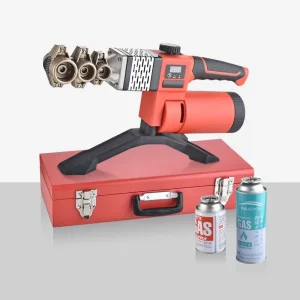
Remote utility installations frequently lack access to stable electrical grids. Innovation in cordless gas-powered PPR fusion welders allows contractors to maintain continuous thermal jointing in greenfield environments without dragging heavy, loud diesel generators.
Zero-Defect Joint Integrity
Thermal socket fusion requires pinpoint temperature regulation within a tight window (±5°C around 260°C). Inconsistent heating leads to pipe wall collapse or cold joints. Modern Chinese factories integrate PTC smart micro-controllers to guarantee repeatable joint homogeneities.
Systemic Sourcing Alignment
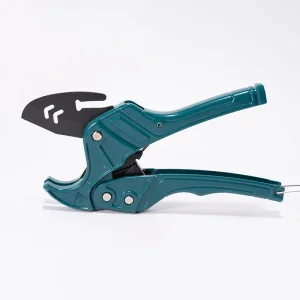
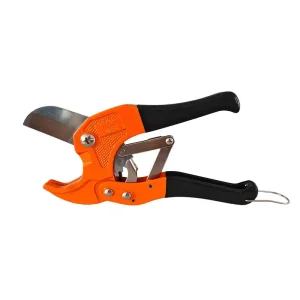
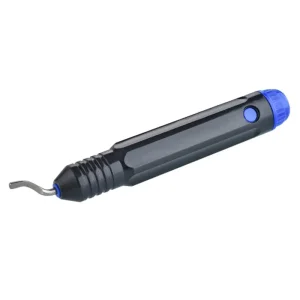
Procurement managers are abandoning piecemeal tool purchasing. Tier-1 buyers demand complete tool ecosystems from single-source manufacturers—combining precision ratcheted shear cutters, multi-diameter deburring reamers, calibrators, and socket fusion machines.
Technology Roadmap: Advanced Thermal Fusion & Mechanical Tooling
Evaluating the key metallurgical, electronic, and mechanical engineering upgrades transforming Chinese pipe fusion equipment into high-yield industrial assets.
1. Dual-Element PTC Heating Modules
Traditional analog heating plates suffer from severe thermal lag and spatial drop-offs. Modern export-grade fusion welders utilize dual-stage PTC (Positive Temperature Coefficient) elements wrapped in aerospace-grade die-cast aluminum heat sinks. This design guarantees rapid thermal recovery times during continuous socket fusion of 20mm to 32mm SDR6/SDR7.4 PPR pipes, eliminating cold-weld seam vulnerabilities.
2. Triple-Layer Japanese PTFE Matrix Coating
The socket and spigot die head coating is the ultimate wear item in field welding. Top-tier factories deploy industrial-grade Japanese Daikin PTFE fluoropolymer matrix coatings applied via electrostatic powder spraying. Withstanding over 3,000 thermal cycles at 280°C, these socket dies resist polymer adhesion, prevent thermal degradation of pipe walls, and ensure effortless pipe insertion and extraction.
3. Ergonomic Progressive Ratcheting Mechanics
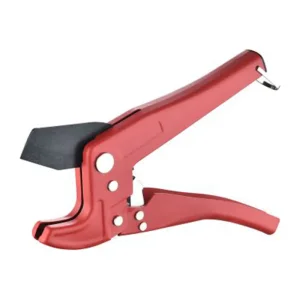
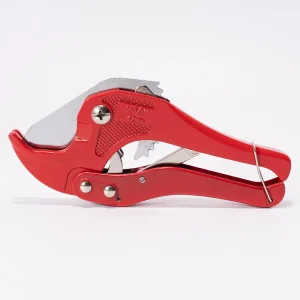
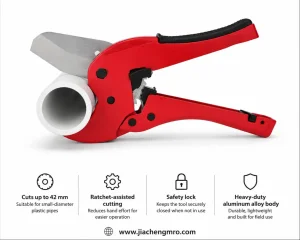
Cutting thick-walled PVC, PEX, and PPR pipes up to 42mm, 50mm, or 75mm without structural ovalization demands sophisticated progressive gear leverage. High-carbon M2 HSS blades paired with die-cast aluminum handles utilize variable-ratio ratchet drive mechanisms. This reduces manual squeeze force by 35%, ensuring precise 90-degree burr-free cuts essential for leak-proof fitting seats.
Manufacturing Infrastructure & Quality Assurance (Yuyao Jiacheng Case Study)
The competitive advantage of leading Chinese pipe tool suppliers stems from vertical integration. Situated in Yuyao, Zhejiang Province—the premier industrial hardware ecosystem of Eastern China—Yuyao Jiacheng Tools Industry and Trade Co., Ltd. operates a specialized 2,667 m² production plant housing over 40 sets of high-precision CNC equipment and automated assembly lines.
| Quality Parameter | Tier-3 Commodity Suppliers | Jiacheng Factory Standard (Tier-1) | Industrial Procurement Benefit |
|---|---|---|---|
| Defect Rate Target | 3.0% – 5.0% | < 0.5% | Drastically lowers warranty returns & brand damage |
| Heating Element Tolerance | ± 15°C (Analog Bimetal) | ± 3°C (PTC Smart Micro-Board) | Prevents cold joints or polymer chain oxidation |
| Blade Material (Cutters) | Low-grade 3Cr13 Stainless | Premium High-Carbon M2 HSS / SK5 | Extends edge sharpness over 5,000 cuts without burrs |
| Global Certifications | Uncertified / Self-declared | ISO9001, SGS, CE Verified Documentation | Guarantees seamless customs clearance worldwide |
| Die Coating Thickness | < 15 microns (Single Pass) | ≥ 35 microns (Triple-pass Japanese PTFE) | Eliminates polymer sticking during thermal socket fusion |
Quality assurance is not merely a final inspection step; it is embedded into the manufacturing lifecycle. Raw aluminum alloy castings undergo spectrographic metal analysis to ensure tensile integrity, while cutting blades undergo automated Rockwell hardness testing (HRC 54-58). Every batch of gas-powered PPR fusion welders is subjected to pressurized gas leak testing and continuous thermal burn-in procedures to ensure compliance with strict European and North American retail audits (such as Lowe's, Kingfisher, and Leroy Merlin vendor requirements).
Engineering Sourcing Guide: Thermoplastic Joining Methods Compared
Selecting the correct pipe joining technology based on jobsite power availability, pipe material (PPR, PE, PVC, PEX-AL-PEX), diameter requirements, and structural pressure ratings.
Socket Fusion Welding
Best for: PPR, PE, PP-R building plumbing (20mm – 110mm).
Mechanics: Simultaneous heating of pipe outer wall and fitting inner wall on a heated socket die. The melted polymers interlock at the molecular level upon insertion.
Key Benefit: Creates a continuous, homogeneous plastic system stronger than the original pipe wall.
Gas-Powered Fusion
Best for: Off-grid repair, emergency municipal work, field agriculture (20mm – 32mm).
Mechanics: Internal micro-gas burner utilizes standard butane/propane canisters to heat the aluminum plate without cords or generators.
Key Benefit: Total mobility, rapid setup (under 3 mins to operational temp), SGS/CE certified safety.
Mechanical Calibration & Pressing
Best for: Multilayer PEX-AL-PEX composite heating & gas systems.
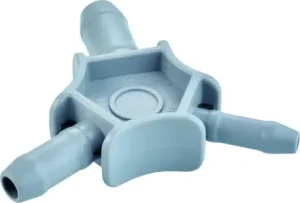
Mechanics: 3-in-1 calibrators re-round cut pipe ends, chamfer the internal edge, and prepare the core for press/compression O-ring fittings.
Key Benefit: Prevents damaged internal rubber seals during press fitting insertion.
OEM/ODM Enterprise Workflow & Regulatory Support
For international tool brands, hardware importers, and industrial supply distributors, partnering with a Chinese manufacturer requires clear communication, robust IP protection, and structured turn-key project management. Premier manufacturers execute private-label production through a standardized five-phase engineering workflow:
01. Intent Mining & Specification
Detailed evaluation of regional pipe standards (ASTM, DIN, ISO, JIS), required voltage/plug configurations, or gas burner specs alongside brand aesthetic guidelines.
02. Precision Prototyping
Fast turnaround 3D solid modeling, custom handle color dipping (anti-slip Ergonomic PVC/TPE), custom mold production, and prototype sampling within 7–14 days.
03. Automated Mass Production
CNC machining of tool bodies, robotic blade grinding, automated heating plate coil winding, and surface powder coating under ISO9001 SOPs.
04. Compliance Certification
Provision of full SGS test reports, CE declarations of conformity, RoHS material compliance certificates, and customized retail blister card or steel case packaging.
Featured Heavy-Duty & Custom Sourcing Solutions
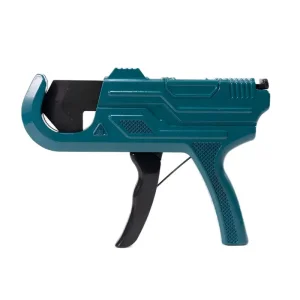
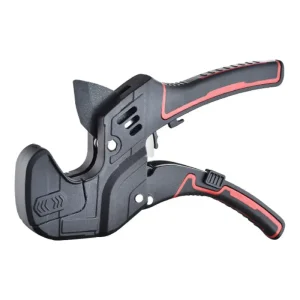
Explore additional precision plumbing tools, heavy-duty ratchet cutters, adjustable PVC shearing units, and specialized fusion equipment ready for global export branding.
Frequently Asked Questions: Technical & Sourcing Knowledge Base
Direct engineering answers to standard procurement, technical, and regulatory questions regarding China pipe welder manufacturing and global delivery.
What is the precise temperature requirement for socket fusion welding of PPR pipes?
The international standard for PPR (Polypropylene Random Copolymer) socket fusion welding (per DIN 16962 and ISO 15874) requires a constant socket die heating temperature of 260°C ± 5°C (500°F ± 9°F). If temperatures drop below 255°C, incomplete polymer chain interdiffusion occurs, leading to cold joints. If temperatures exceed 270°C, thermal degradation of the polymer occurs, resulting in pipe wall thinning or flow restrictions due to internal melt bead collapse. Premier Chinese manufacturers integrate digital micro-processor PTC heating controls to strictly lock temperatures within this range.
How does a gas-powered PPR fusion welder operate without electrical power?
A gas-powered PPR fusion welder (such as Jiacheng's SGS/CE-certified 1.4KW model) utilizes a high-efficiency micro-gas burner module fed by standard portable butane or propane micro-canisters. The internal combustion chamber is engineered with a thermal distribution plate that evenly heats the die sockets to the required 260°C within 3 minutes. Gas flow regulators allow micro-adjustments for ambient temperatures and wind conditions, rendering it the ideal tool for remote jobsites, emergency utility repairs, and off-grid construction where generators are impractical.
Why is a 3-in-1 pipe calibrator necessary prior to installing PEX-AL-PEX multilayer fittings?
When cutting PEX-AL-PEX (polyethylene-aluminum-crosslinked polyethylene) composite pipes, shear cutters naturally crush the circular profile into an oval shape while creating sharp internal aluminum edges. Inserting a fitting into an uncalibrated pipe will displace or slice the internal EPDM O-rings, leading to immediate or latent joint leaks under hydraulic pressure. A 3-in-1 calibrator performs three vital operations simultaneously: (1) Re-rounds the pipe profile, (2) Internal chamfering to guide fitting insertion, and (3) Internal wall deburring to protect rubber sealing rings.
What steel grades are used in high-durability plastic pipe cutter blades?
Professional-grade pipe cutter blades manufactured by Tier-1 Chinese suppliers utilize SK5 carbon tool steel or M2 High-Speed Steel (HSS). Blades undergo vacuum heat treatment and precision CNC bevel grinding to achieve a Rockwell hardness rating of HRC 54 to 58. This edge geometry allows clean, square cuts through hard PVC, flexible PEX, and dense PPR pipes up to 42mm, 50mm, or 75mm without cracking the pipe wall or dulling the cutting edge over thousands of cycles.
What certifications should B2B procurement managers require when importing pipe tools from China?
Procurement teams must demand verifiable third-party documentation including: (1) ISO9001 Quality Management Certification for the factory production facility, (2) CE Mark & Low Voltage / Electromagnetic Compatibility (LVD/EMC) Test Reports for electrical fusion welders entering the European Union, (3) SGS Safety Certification for gas-powered equipment, and (4) RoHS/REACH Material Compliance proving that tool handles, dip coatings, and paints are free of hazardous heavy metals and phthalates.